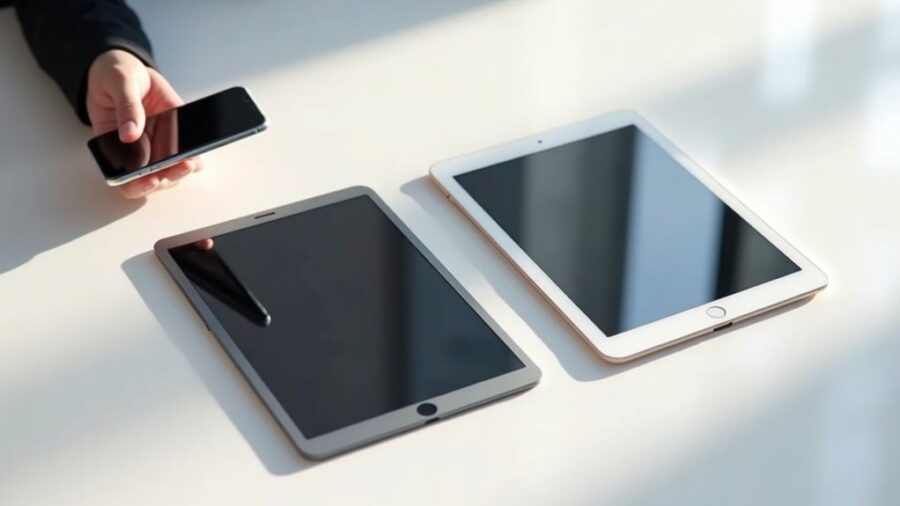
The decision between Apple’s M2 iPad Pro and iPad Air presents a significant technological crossroads for consumers. Each device offers distinct advantages in design, performance, and value that cater to different user profiles. The Pro delivers premium features with its advanced display and processing capabilities, while the Air balances functionality with affordability. Understanding the key differences between these tablets helps determine which device aligns with specific needs and budget constraints. The comparison extends beyond mere specifications into practical considerations of daily use.
Key information
- The M4 iPad Pro offers superior performance with a 9-10 core CPU compared to the M2 iPad Air’s 8-core CPU for demanding tasks.
- iPad Pro’s OLED Ultra Retina XDR display with 1,600 nits peak brightness outshines the Air’s 60Hz IPS panel with 600 nits.
- Both offer similar 10-hour battery life, but the Pro includes Thunderbolt 4 connectivity with 40 Gbps transfer speeds versus Air’s 10 Gbps USB-C.
- The Pro provides higher storage options up to 2TB with 16GB RAM upgrades, while the Air maxes at 256GB storage with fixed 8GB RAM.
- iPad Air offers better value for casual users, while the Pro’s premium features justify its higher price for professionals needing advanced capabilities.
Numeric List of 10 Second-Level Headings
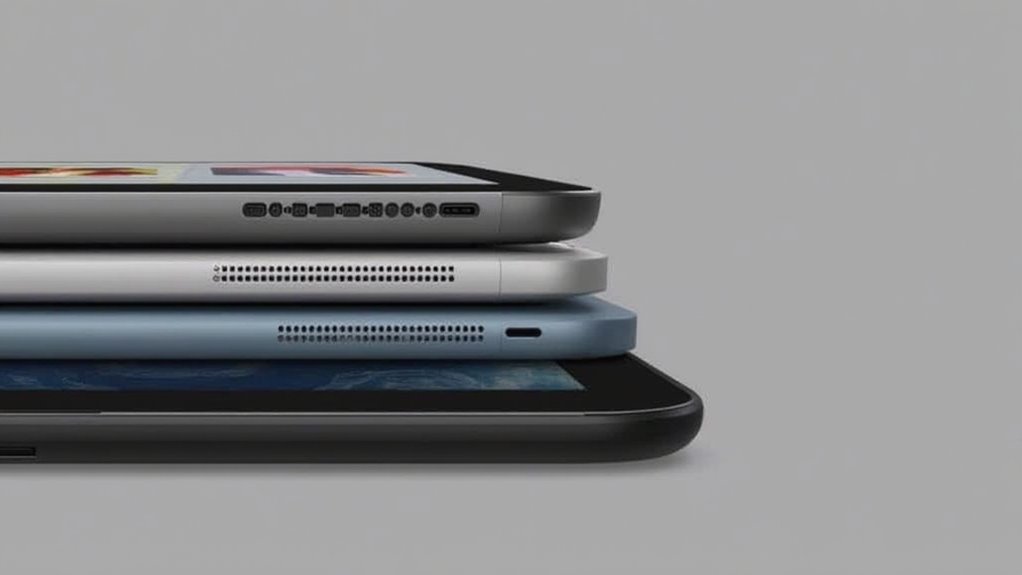
When comparing the M2 iPad Pro and iPad Air, understanding the key differences across various aspects helps consumers make informed purchasing decisions. The following second-level headings provide a structured framework for analyzing these premium tablets:
- Processing Power: M4 Chip vs M2 Performance
- Display Technology: OLED Ultra Retina XDR vs IPS Panel
- Connectivity Options: Thunderbolt 4 Capabilities
- RAM Configuration and Multitasking Potential
- Audio System Comparison and Media Experience
- Professional Applications: Video Editing Performance
- Battery Life and Power Efficiency
- Storage Options and Expandability
- Price-to-Performance Ratio Analysis
- Target User Profiles and Use Cases
These categories highlight the technical specifications where the M2 iPad Pro offers substantial advantages, particularly for professional users requiring improved performance for resource-intensive tasks, a fact underscored by the device’s capabilities in handling połączenia z iPada.
Design and Build Quality Comparison
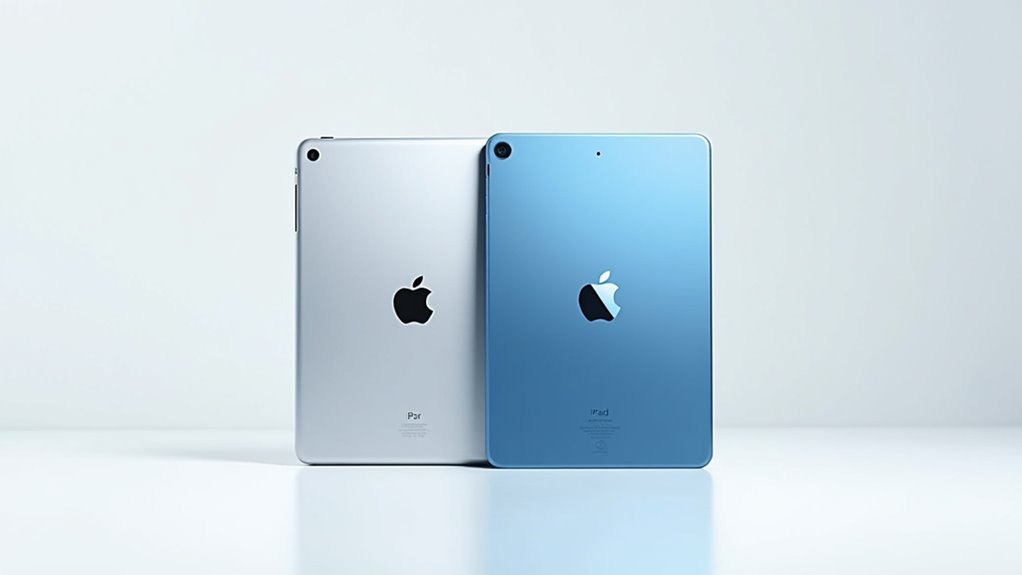
Moving from the structural overview of our comparison points, the physical design and build quality represent significant differentiating factors between these premium tablets. The M2 iPad Pro showcases an impressively slim profile at just 5.3 mm for the 11-inch model and an even thinner 5.1 mm for the 13-inch variant, while the iPad Air maintains its previous generation’s dimensions. Both devices feature the characteristic squared edges and premium metal finish that define Apple’s current design language.
Weight differences are notable, with the M2 iPad Pro weighing a mere 444g for the 11-inch model, making it more lightweight than the iPad Air. The Pro’s tandem OLED Ultra Retina XDR display delivers exceptional visual performance with peak brightness reaching 1,600 nits in HDR content, substantially outperforming the iPad Air’s 60Hz IPS panel limited to 600 nits.
Display Technology and Visual Experience
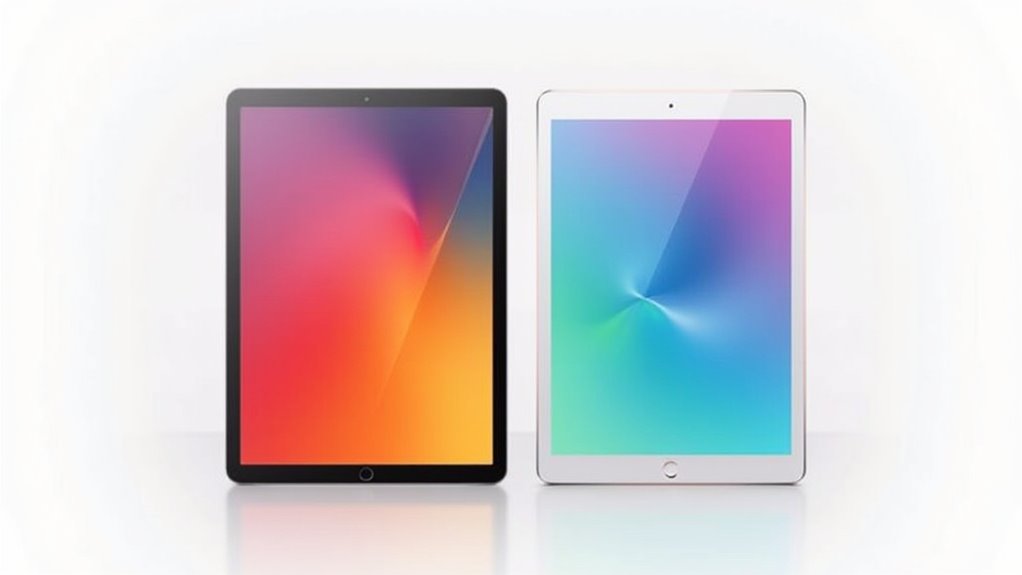
The visual experience gap between the M4 iPad Pro and iPad Air becomes immediately apparent when examining their display technologies. The M4 iPad Pro features a tandem OLED Ultra Retina XDR display delivering 1,600 nits peak brightness in HDR content, greatly outperforming the iPad Air’s 60Hz IPS panel with its 600 nits maximum brightness.
While both devices support P3 wide color, making them suitable for creative work, the Pro model’s OLED technology provides superior color accuracy and true blacks that improve visual experiences across all media-heavy tasks. At just 5.3mm thick, the Pro’s display contributes to its lighter 444g weight for the 11-inch model, combining portability with premium visuals. For professionals regularly working with high-resolution content, the Pro’s advanced display capabilities represent a considerable upgrade over the Air’s still-capable but less sophisticated screen.
Processing Power: M2 Vs M3 Chip Performance
Beyond their visual differences, the iPad Pro and iPad Air differ greatly in their computational capabilities. The iPad Air utilizes the M2 chip with an 8-core CPU and 10-core GPU, suitable for everyday tasks and casual usage. Meanwhile, the iPad Pro features the advanced M4 chip with a 9 or 10-core CPU and 10-core GPU, specifically engineered for resource-intensive applications.
The M4 chip’s architecture includes dedicated media engines and hardware-enabled ray tracing, considerably enhancing performance in graphic-heavy applications. Both devices start with 8GB of RAM, but the Pro offers a 16GB upgrade option with 1TB storage, improving multitasking capabilities. Another notable difference is connectivity—the Pro supports Thunderbolt 4 with 40 Gbps transfer speeds, quadrupling the Air’s 10 Gbps limit and enabling faster data transfer with external devices.
Battery Life and Charging Capabilities

When examining battery performance, both the M2 iPad Pro and iPad Air offer impressive 10-hour battery life for standard tasks like web browsing and video playback, making either device suitable for all-day use without frequent recharging. The charging capabilities reveal subtle differences, with both models supporting fast charging that can reach 50% capacity in approximately 30 minutes when paired with compatible power adapters. Nevertheless, the M2 iPad Pro distinguishes itself with Thunderbolt 4-compatible USB-C ports for charging and data transfer, while the iPad Air utilizes standard USB-C with transfer speeds up to 10 Gbps, potentially influencing long-term power management for professional users with demanding workflows.
Battery Life Comparison
Both iPad models offer impressive endurance for users seeking reliable battery performance throughout the day. The M2 iPad Pro and iPad Air both deliver approximately 10 hours of battery life when web surfing on Wi-Fi under similar usage conditions. This consistency across both devices makes either option viable for professionals and casual users alike.
What sets the M2 iPad Pro apart is its advanced power management system, which optimizes energy consumption during resource-intensive tasks. Nevertheless, both tablets feature efficient battery management systems that help extend operational time during demanding applications. They additionally support USB-C fast charging, allowing users to reach approximately 50% battery in just 30 minutes with a compatible charger.
It’s worth noting that actual battery life may vary based on individual usage patterns, device settings, and environmental factors.
Charging Speed Differences
In spite of sharing similar total battery endurance, the M2 iPad Pro and iPad Air differ markedly in their charging capabilities and speeds. The M2 iPad Pro delivers substantially faster charging with its 20W power adapter, reaching approximately 50% capacity in just 30 minutes—a significant advantage over the iPad Air’s slower charging rate.
The Pro model’s Thunderbolt 4 compatibility further boosts its versatility, allowing connection to high-speed accessories while charging, whereas the iPad Air is restricted to standard USB-C connections with lower data transfer rates. Power users will appreciate the Pro’s optional higher wattage adapter for even quicker recharging, an option unavailable for the Air model.
While both devices offer the same 10-hour rating for standard tasks, the M2 chip’s superior efficiency in the Pro improves battery performance during demanding applications.
Power Management Features
The extensive power management features of both iPad models extend beyond simple charging capabilities into sophisticated systems designed for peak performance. Both the M2 iPad Air and M4 iPad Pro deliver approximately 10 hours of battery life for web browsing or video playback, with intelligent power management systems that dynamically adjust performance based on usage patterns.
The M4 iPad Pro demonstrates slightly superior efficiency during resource-intensive tasks, thanks to optimizations between the M4 chip and its battery. Both devices support fast charging, reaching 50% capacity in roughly 30 minutes with a 20W adapter. While both utilize USB-C ports, the iPad Pro’s Thunderbolt 4 connectivity offers additional power management advantages for peripherals. These thoughtful implementations guarantee users experience consistent performance without sacrificing battery longevity, regardless of which model they choose.
Storage Options and RAM Configurations
The M2 iPad Pro and iPad Air differ greatly in their memory configurations, with the Pro offering both 8GB and 16GB RAM options while the Air standardizes at 8GB across all models. Storage capacity likewise creates a clear distinction between the devices, as the Pro model extends from 128GB to a substantial 1TB, whereas the Air’s options are limited to 64GB and 256GB. These differences in RAM and storage directly impact performance capabilities, with the Pro’s higher-tier configurations enabling more demanding professional workflows such as complex video editing and 3D rendering that might prove challenging on the Air’s more modest specifications.
Storage Tiers Comparison
Several significant differences emerge when examining the storage configurations between the M2 iPad Air and M4 iPad Pro models. The M2 iPad Air comes with more limited options of 64GB and 256GB, while the M4 iPad Pro offers a broader range with 128GB, 256GB, 512GB, and up to 2TB configurations to accommodate professional needs.
- The M4 iPad Pro’s higher storage tiers activate an additional CPU core, boosting performance for demanding applications
- Both devices start with 8GB RAM, but the Pro can be upgraded to 16GB when selecting the 1TB storage option
- The M2 iPad Air’s 64GB base model is sufficient for everyday tasks but may limit professional workflows
- Users working with high-resolution media files will benefit from the M4 iPad Pro’s extensive storage options
RAM Performance Differences
While both iPad models feature the same baseline RAM configuration, significant performance differences emerge when examining their memory architectures in detail. Both the M2 iPad Air and M4 iPad Pro start with 8GB of RAM, but the Pro offers a substantial upgrade to 16GB when configured with 1TB or more storage. This memory improvement dramatically improves multitasking capabilities for resource-intensive applications.
The M4 iPad Pro’s RAM performance is further optimized by dedicated media engines and advanced hardware capabilities, making it particularly effective for video editing and graphic design workflows. These performance optimizations allow the Pro to handle multiple simultaneous processes with greater efficiency. Meanwhile, the M2 iPad Air, though limited to 8GB RAM across all storage options (up to 1TB), still delivers solid performance for everyday tasks, but may reach limitations with professional-grade applications.
Camera Systems and Video Recording Features
Photographers and videographers will find remarkable differences between the camera systems of the M2 iPad Pro and iPad Air, in spite of some shared specifications. Both devices offer quality options for content creation, with the Pro model delivering improved capabilities for professional applications.
- Both models feature identical 12MP front cameras optimized for landscape orientation video calls
- The M2 iPad Pro’s four-mic array provides superior audio quality during video recording
- LiDAR scanner exclusive to the Pro model boosts AR applications and improves depth sensing
- While both support 4K video recording at various frame rates (24, 30, or 60 fps), the Pro includes an adaptive flash for better document scanning
These differences make the Pro version more suitable for users who prioritize advanced photography features and professional-grade video recording capabilities.
Connectivity and Port Selection
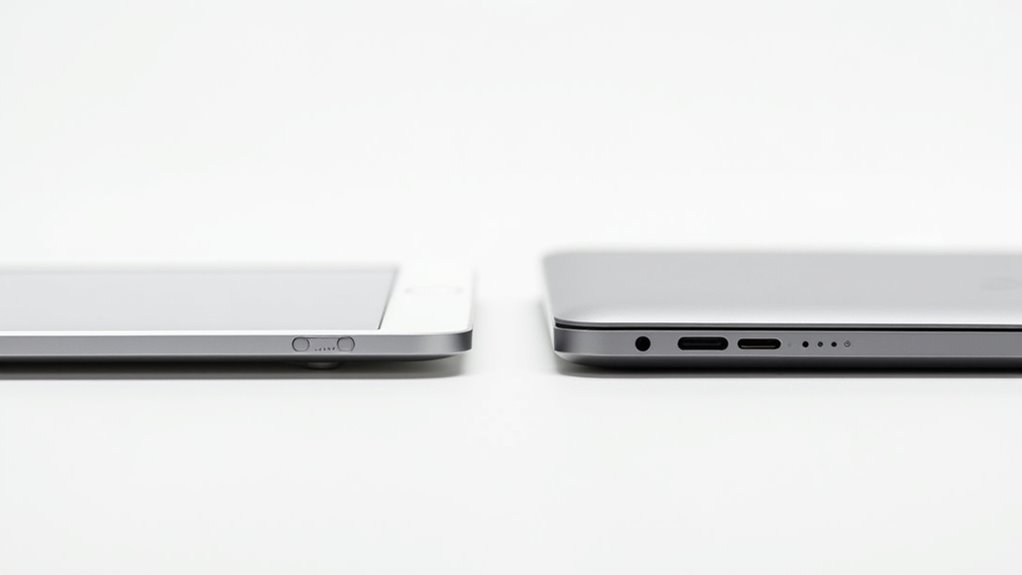
Connectivity options represent a vital distinction between the M2 iPad Pro and iPad Air, with significant implications for professional users and content creators. The M2 iPad Pro features Thunderbolt 4 technology, delivering impressive data transfer speeds of up to 40 Gbps, while the iPad Air employs a standard USB-C port limited to 10 Gbps. This difference becomes essential when connecting to external displays or transferring large files.
Both devices offer Wi-Fi 6E and cellular connectivity options, though the Pro model provides improved 5G capabilities in supported markets. The iPad Air includes Bluetooth 5.3, ensuring reliable connections with wireless accessories. The Pro’s Thunderbolt port provides broader compatibility with professional accessories and peripherals, making it more versatile for demanding workflows that require multiple connected devices simultaneously.
Compatible Accessories and Ecosystem Integration
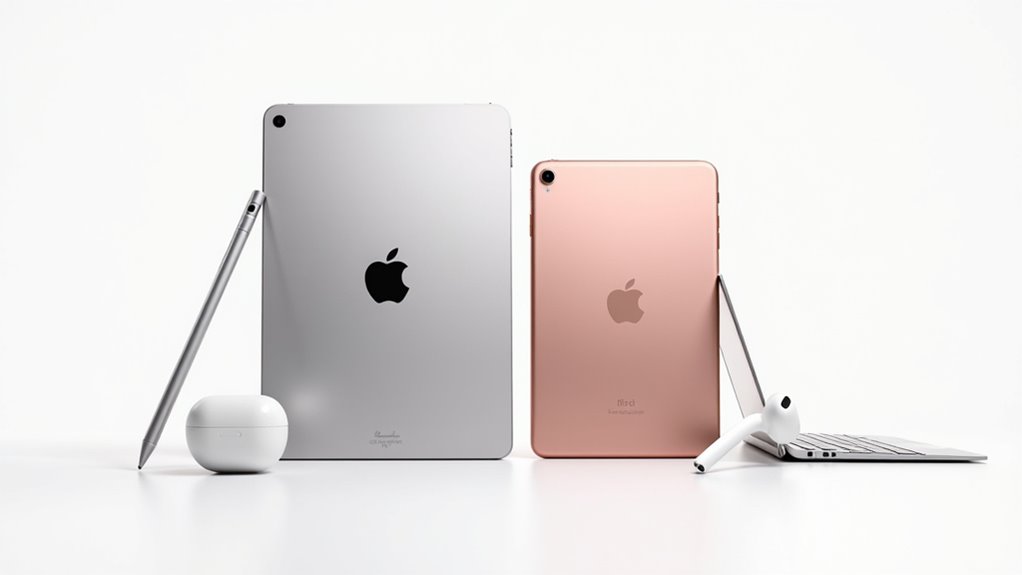
Both the M2 iPad Pro and iPad Air offer substantial accessory compatibility, though with notable differences in scope and performance capabilities. The M2 iPad Pro delivers improved accessory support with its Thunderbolt 4 connectivity, enabling faster data transfer and compatibility with high-performance peripherals that benefit professional workflows.
While both iPads support many accessories, the M2 iPad Pro’s Thunderbolt 4 connectivity unlocks professional-grade peripheral possibilities unavailable to the Air.
- The M2 iPad Pro works with the newest Magic Keyboard featuring a function row and haptic touchpad, while the iPad Air uses the previous generation keyboard
- Both tablets support the 2nd generation Apple Pencil, ensuring consistent drawing and note-taking experiences
- Universal Control and Sidecar functionality work seamlessly across both models when paired with Mac computers
- The Pro’s four-speaker audio system provides superior sound quality for media consumption when connected to compatible accessories
Price Point Analysis and Value Proposition
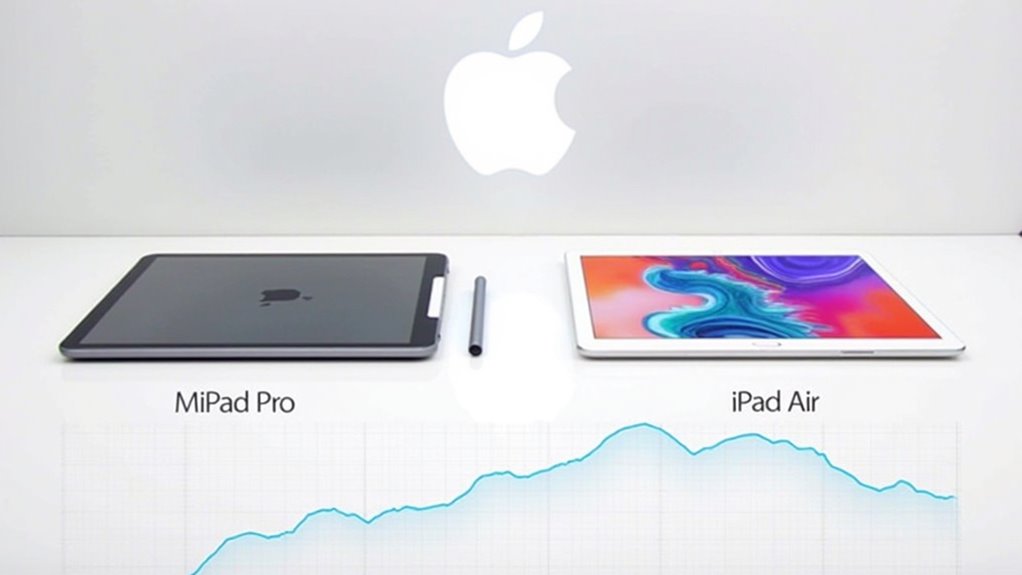
The M2 iPad Air provides a compelling entry point with a more accessible price tag compared to the premium positioning of the M4 iPad Pro. When examining the storage-to-price ratio, consumers must evaluate whether the Pro’s higher configurations justify the additional investment against the Air’s more modest but capable offerings. The long-term value assessment extends beyond initial purchase price to gauge device longevity, with the Pro’s advanced chipset potentially offering extended relevance for power users while the Air remains sufficient for mainstream computing needs.
Raw Cost Comparison
Price considerations represent one of the most significant factors when choosing between the M2 iPad Air and M4 iPad Pro models. The M2 iPad Air stands out as the more budget-friendly option, with a significantly lower starting price compared to the M4 iPad Pro counterpart.
- M2 iPad Air offers solid value proposition for users who don’t require advanced capabilities
- M4 iPad Pro commands a premium price justified by performance features like Thunderbolt 4
- Price difference becomes more pronounced in higher storage configurations
- Budget constraints often determine choice, with the Air sufficient for general tasks
The cost disparity between these models reflects their positioning in Apple’s ecosystem, with the Pro targeted at professionals requiring improved performance for creative work, while the Air serves users seeking capable hardware without specialized features.
Storage-to-Price Ratio
Evaluating the storage-to-price ratio reveals significant differences between the M2 iPad Air and M4 iPad Pro models that extend beyond their baseline costs. The iPad Air, with its lower price point, offers storage capacities up to 256GB, providing adequate space for everyday tasks and general use. In comparison, the iPad Pro justifies its premium pricing with configurations reaching 2TB, appealing to professionals handling extensive media files.
Both devices start with 8GB of RAM, but the Pro distinguishes itself with a 16GB option in higher-tier configurations. This improved memory, combined with Thunderbolt speeds of 40 Gbps, creates substantial value for professionals requiring seamless handling of resource-intensive applications. When evaluating overall value, the Air delivers excellent performance for typical users, while the Pro’s advanced specifications and expanded storage options represent a justified investment for creative professionals notwithstanding the higher initial outlay.
Long-term Value Assessment
Conducting a thorough long-term value assessment reveals significant differences between the M2 iPad Air and M4 iPad Pro that extend beyond their initial purchase prices. While the M2 iPad Air offers a budget-friendly entry point with performance sufficient for everyday tasks, the M4 iPad Pro presents compelling advantages for those requiring advanced capabilities for creative work.
- The M4 iPad Pro’s Thunderbolt 4 support guarantees compatibility with high-performance peripherals for years to come
- Professional users may find better return on investment through the iPad Pro’s superior graphics performance and display quality
- The M2 iPad Air maintains excellent value for general computing needs without the premium price tag
- Higher-end iPad Pro models typically maintain stronger resale value, offsetting a portion of the initial price difference over time
FAQ
What Is the Key Difference Between Ipad Pro and Ipad Air?
The key difference lies in performance and display technology. The iPad Pro offers superior M4 chip performance, advanced OLED display, Thunderbolt 4 support, and professional features, while the iPad Air provides balanced capabilities at a lower price.
Which Ipad Is Better for Students Air or Pro?
The choice depends on student needs. The Air balances budget considerations with good performance, while the Pro offers superior performance for demanding applications. Both provide excellent portability, battery life, app compatibility, and accessory options.
Is the Ipad Air Better Than the Ipad Screen Quality?
No, the iPad Air is not better in screen quality. The iPad Pro offers superior display technology with OLED panel type, higher refresh rate, greater brightness levels, better color accuracy, and improved viewing angles.
Conclusion
The choice between the M2 iPad Pro and iPad Air ultimately depends on individual requirements and budget constraints. The Pro excels with its OLED display, superior processing capabilities, and extensive connectivity options for professionals and power users. Meanwhile, the iPad Air offers a compelling balance of performance and affordability for everyday users. Consumers should assess their specific needs against each device’s features to determine which represents the better investment for their circumstances.